
Who Are the Greatest Stand-Up Comedians of All Time?
Who are the greatest stand-up comedians of all time? Comedy fans have debated that question for generations, and there is no single objective answer.
Greatness in stand-up is about more than simply getting the biggest laugh. A truly great comedian can combine an extraordinary body of work with originality, memorable performances, stagecraft, longevity, influence and an ability to connect with audiences across generations.
For this ranking, Comedyville looked specifically at each comedian’s stand-up career. Film success, television fame and commercial popularity can add context, but they do not automatically make someone one of the greatest stand-up performers ever.
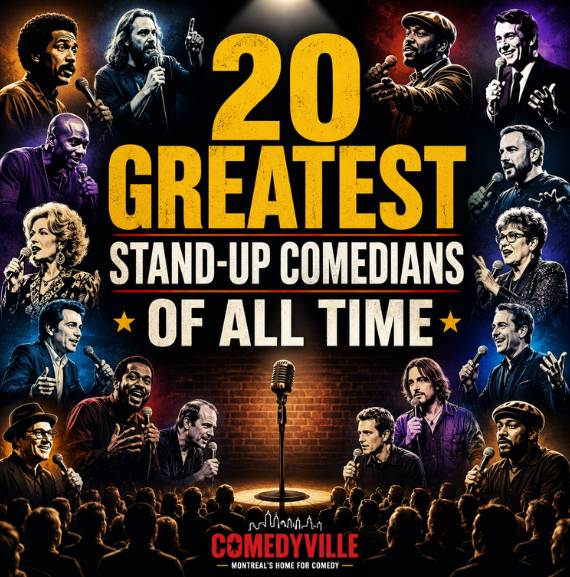
From Richard Pryor and George Carlin to Dave Chappelle, Joan Rivers and Robin Williams, here are Comedyville’s picks for the 20 greatest stand-up comedians of all time.
Quick Ranking: 20 Greatest Stand-Up Comedians Ever
| Rank | Comedian | Known For |
|---|---|---|
| 1 | Richard Pryor | Fearless storytelling, characters and emotional honesty |
| 2 | George Carlin | Social commentary, language and constant reinvention |
| 3 | Dave Chappelle | Storytelling, stagecraft and cultural observation |
| 4 | Eddie Murphy | Charisma, impressions and explosive stage presence |
| 5 | Chris Rock | Precision writing, rhythm and social commentary |
| 6 | Robin Williams | Improvisation, characters and extraordinary energy |
| 7 | Joan Rivers | Fearless joke writing, longevity and groundbreaking stand-up |
| 8 | Jerry Seinfeld | Observational comedy and precision joke construction |
| 9 | Bill Burr | Argument-driven comedy and a distinctive modern voice |
| 10 | Norm Macdonald | Deadpan delivery, misdirection and originality |
| 11 | Lenny Bruce | Boundary-pushing material and historical importance |
| 12 | Steve Martin | Absurdism, performance innovation and arena-level stand-up |
| 13 | Rodney Dangerfield | One-liners, self-deprecation and unforgettable persona |
| 14 | Don Rickles | Insult comedy, improvisation and audience interaction |
| 15 | Steven Wright | Surreal one-liners and unmistakable deadpan delivery |
| 16 | Redd Foxx | Adult comedy, storytelling and groundbreaking recordings |
| 17 | Phyllis Diller | Distinctive persona, joke writing and pioneering career |
| 18 | Bernie Mac | Commanding stage presence and unmistakable storytelling |
| 19 | Patrice O’Neal | Conversational comedy, honesty and crowd command |
| 20 | Mitch Hedberg | Surreal one-liners and distinctive joke construction |
How We Ranked the Greatest Stand-Up Comedians
Comedy is subjective, so this is an editorial ranking, not the result of a mathematical formula or a single public poll.
We considered several factors when evaluating each comedian:
- Body of work: The overall quality and importance of their stand-up albums, specials and live performances.
- Peak performances: How extraordinary the comedian was when performing at their best.
- Originality: Whether the comedian developed a recognizable voice or changed how stand-up could be performed.
- Longevity: The ability to produce strong material and remain relevant across different stages of a career.
- Stagecraft: Joke writing, storytelling, timing, delivery, improvisation and command of an audience.
- Influence: The extent to which later comedians learned from or built upon their work.
- Cultural impact: Whether their comedy reached beyond individual performances and became part of the broader culture.
No single factor determines the ranking. A comedian with enormous influence does not automatically outrank someone with a stronger overall stand-up career, just as commercial success alone does not determine greatness.
1. Richard Pryor
Richard Pryor sits at the top because few performers changed stand-up while simultaneously mastering so many of its essential elements.
Pryor could tell deeply personal stories, disappear into characters, imitate voices and turn painful experiences involving race, relationships, addiction and his own mistakes into extraordinary comedy. His performances could feel spontaneous and vulnerable while remaining remarkably controlled.
More importantly, Pryor expanded what audiences expected from a stand-up comedian. He demonstrated that comedy could be brutally honest and emotionally complicated without sacrificing laughs.
Why he ranks #1: Pryor combined innovation, storytelling, character work, vulnerability, influence and unforgettable live performance at an extraordinarily high level.
Essential Watch: Richard Pryor: Live in Concert (1979)
2. George Carlin
George Carlin’s career is one of the strongest arguments for longevity and reinvention in stand-up history.
Over several decades, Carlin evolved from a relatively conventional performer into one of comedy’s sharpest observers of language, politics, religion, consumer culture and human behaviour.
His greatest strength was not simply having opinions. It was turning complicated ideas into tightly constructed comedy with a voice that remained unmistakably his own.
Why he ranks #2: Few comedians produced important work across such a long period while continuing to evolve creatively.
Essential Watch: Jammin’ in New York (1992)
3. Dave Chappelle
Dave Chappelle has become one of the defining stand-up performers of the modern era.
His conversational delivery can make extended routines feel effortless. Chappelle often begins with a simple story or observation before gradually developing it into something larger involving culture, race, fame, politics or human behaviour.
His control of silence, pacing and audience tension is particularly distinctive. He can slow a room down rather than constantly chasing the next punchline.
Why he ranks #3: Chappelle combines storytelling, stage presence, cultural relevance and command of an audience at a level few contemporary performers have matched.
Essential Watch: Killin’ Them Softly (2000)
4. Eddie Murphy
Eddie Murphy’s stand-up career reached extraordinary heights while he was still remarkably young.
Murphy brought charisma, impressions, physicality, voices and almost rock-star confidence to the stage. His performances demonstrated how enormous stand-up could feel when a comedian possessed complete command of a room.
His recorded stand-up output is smaller than that of several comedians ranked around him, but the magnitude of his peak is difficult to ignore.
Why he ranks #4: Few comedians have ever possessed Murphy’s combination of charisma, performance ability and cultural impact at their peak.
Essential Watch: Delirious (1983)
5. Chris Rock
Chris Rock developed one of the most recognizable rhythms in modern stand-up.
His strongest routines take complicated subjects involving race, relationships, politics, money and American culture and organize them into carefully structured arguments. Repetition, pacing and escalating punchlines turn those arguments into performances that feel almost musical.
Why he ranks #5: Rock combines elite joke writing with a distinctive delivery and an ability to turn social observation into accessible mainstream stand-up.
Essential Watch: Bring the Pain (1996)
6. Robin Williams
Few comedians have ever appeared to think as quickly onstage as Robin Williams.
Williams could move between characters, accents, physical comedy, impressions and cultural references at extraordinary speed. His improvisational ability made performances feel unpredictable even when he was working within established material.
His stand-up also demonstrated how theatrical the form could become in the hands of a performer with exceptional acting and improvisational skills.
Why he ranks #6: Williams possessed a combination of improvisation, physical performance, characters and pure comic energy that remains almost impossible to duplicate.
Essential Watch: Live on Broadway (2002)
7. Joan Rivers
Joan Rivers built one of the longest and most fearless careers in stand-up comedy.
Her rapid-fire delivery, aggressive joke writing and willingness to target celebrities, social conventions and herself made her instantly recognizable. She continued writing and performing for decades rather than simply relying on material from her early career.
Rivers also succeeded during a period when female stand-up comedians faced far fewer opportunities in the industry.
Why she ranks #7: Longevity, fearless writing, cultural importance and an enormous volume of material make Rivers essential to any serious discussion of stand-up greatness.
Related: Funniest Female Stand-Up Comedians of All Time
8. Jerry Seinfeld
Jerry Seinfeld helped make observational comedy one of the dominant forms of modern stand-up.
His material focuses on ordinary behaviour, language, relationships and tiny social rituals that audiences recognize immediately. The apparent simplicity hides an obsessive attention to wording, rhythm and joke construction.
Seinfeld also demonstrated that a comedian could build an enormous career without abandoning relatively clean observational material.
Why he ranks #8: His precision, longevity and influence on observational stand-up are difficult to overstate.
9. Bill Burr
Bill Burr built a distinctive style around frustration, argument and contradiction.
A typical Burr routine may begin with an aggressive opinion before gradually becoming an argument with himself. That ability to expose his own flaws prevents the material from becoming a simple lecture and gives his stand-up an unpredictable quality.
His longevity across specials, touring and audio has also made him one of the defining stand-up voices of his generation.
Why he ranks #9: Burr combines a highly recognizable voice with consistency, strong writing and exceptional command of long-form arguments.
10. Norm Macdonald
Norm Macdonald seemed almost determined to tell jokes differently from everyone else.
His deliberate pacing, deadpan delivery, misdirection and willingness to stretch a premise far beyond where an audience expected it to go created an unmistakable comic voice.
Macdonald’s reputation among fellow comedians became an important part of his legacy, but the stand-up itself is what earns his place here.
Why he ranks #10: Originality matters in an all-time ranking, and very few comedians sounded anything like Norm Macdonald.
11. Lenny Bruce
Lenny Bruce occupies a unique place in stand-up history.
His willingness to confront religion, politics, sexuality, censorship and social hypocrisy helped expand what comedians could discuss publicly. His battles over obscenity also became inseparable from his legacy.
Bruce would rank even higher on a list based purely on historical influence. On this list, however, influence is only one component of an overall stand-up career.
Why he ranks #11: Modern stand-up’s willingness to challenge social boundaries owes an enormous debt to Bruce.
12. Steve Martin
Steve Martin turned absurdity itself into a stand-up persona.
Rather than simply telling conventional jokes, Martin played with the expectations of what a comedian was supposed to do onstage. His act could include deliberately ridiculous premises, physical comedy, music and carefully constructed nonsense.
At his commercial peak, Martin also helped demonstrate that stand-up comedians could perform for enormous audiences.
Why he ranks #12: Martin combined originality, performance innovation and huge mainstream appeal without losing the strangeness that made his comedy distinctive.
13. Rodney Dangerfield
Rodney Dangerfield created one of the most recognizable personas in comedy history.
His self-deprecating “no respect” character provided a framework for an extraordinary number of tightly constructed one-liners. The character was simple enough to understand instantly but flexible enough to support decades of jokes.
Why he ranks #13: Dangerfield demonstrated just how powerful a clear comic persona and relentless joke writing could be.
14. Don Rickles
Don Rickles transformed insult comedy into an art of live interaction.
His ability to work a room depended on much more than simply insulting people. Timing, improvisation, charm and an ability to understand exactly how far he could push an audience made Rickles a formidable live performer.
Why he ranks #14: Few comedians exercised greater spontaneous command over an audience.
15. Steven Wright
Steven Wright proved that enormous laughs could come from doing almost nothing physically.
His slow, emotionless delivery became the perfect vehicle for surreal observations and one-liners that twisted logic in unexpected directions.
The contrast between the absurdity of the writing and the seriousness of the delivery created a style that was immediately identifiable.
Why he ranks #15: Wright developed one of stand-up’s purest examples of a completely distinctive comic voice.
16. Redd Foxx
Redd Foxx was performing boundary-pushing adult comedy long before many later stand-up stars became household names.
His nightclub performances and comedy recordings helped establish an audience for material that mainstream television would not touch at the time.
His later television fame sometimes overshadows how important his earlier stand-up career was.
Why he ranks #16: Foxx helped create space for more candid adult stand-up and influenced generations of performers who followed.
17. Phyllis Diller
Phyllis Diller built an unmistakable stage persona at a time when relatively few women were able to establish major careers in stand-up.
Her eccentric appearance, exaggerated laugh, rapid joke writing and self-deprecating material made her instantly recognizable.
Behind the persona was a disciplined performer who helped expand the possibilities for women in professional comedy.
Why she ranks #17: Diller combined originality, longevity and historical importance with a genuinely distinctive stand-up act.
18. Bernie Mac
Bernie Mac possessed the kind of stage authority that could transform the atmosphere of an entire room.
His storytelling, voice, facial expressions and physical presence gave his stand-up an unmistakable identity. His performance in The Original Kings of Comedy introduced that power to an even wider audience.
Why he ranks #18: Mac’s combination of storytelling, authenticity and stage command made him one of the most compelling live performers of his generation.
19. Patrice O’Neal
Patrice O’Neal developed a conversational style that could make stand-up feel like an argument happening in real time.
He was comfortable challenging an audience, following an idea into uncomfortable territory and allowing interactions in the room to reshape where the performance went next.
His career was cut short, but his reputation among comedians and dedicated stand-up fans has continued to grow.
Why he ranks #19: O’Neal’s originality, honesty and extraordinary conversational control made him a singular performer.
20. Mitch Hedberg
Mitch Hedberg could take an ordinary object or situation and approach it from an angle almost nobody else would imagine.
His short jokes often depended on strange logic, unexpected wording and observations that became funnier precisely because they seemed to arrive from nowhere.
His distinctive delivery and writing helped build a devoted following that continued long after his death.
Why he ranks #20: Hedberg created one of the most recognizable one-liner styles in modern stand-up.
Greatest vs. Funniest vs. Most Influential
The words greatest, funniest and most influential are often used interchangeably when people discuss comedians, but they do not necessarily mean the same thing.
This ranking asks the broadest question: Who had the greatest overall stand-up careers? That means considering body of work, peak performance, originality, longevity, stagecraft, influence and cultural impact together.
A ranking focused primarily on who delivers the biggest laughs can produce a different result. See Comedyville’s Funniest Stand-Up Comedians of All Time for that discussion.
Likewise, historical influence deserves its own examination. Some comedians changed the direction of stand-up even if their complete careers would rank differently when judged against every other factor.
Honourable Mentions
Twenty positions cannot capture the entire history of stand-up comedy. Many other performers deserve to be part of the conversation.
Bob Newhart brought remarkable precision and understated storytelling to comedy albums and live performance. Wanda Sykes developed a distinctive observational and political voice. Maria Bamford pushed character work and deeply personal comedy in unusual directions. Louis C.K. became highly influential in modern joke writing and confessional stand-up. Kevin Hart helped take stand-up to enormous international audiences.
Other important names include Ali Wong, John Mulaney, Margaret Cho, Sarah Silverman, Ricky Gervais, Tig Notaro, Dave Attell and Paul Mooney.
How Stand-Up Greatness Changes Across Generations
Comparing comedians from different generations is difficult because the art form itself keeps changing.
Earlier performers built careers through nightclubs, comedy albums and television appearances. Later generations benefited from cable television and filmed specials. Today, streaming platforms, podcasts and social media allow comedians to build international audiences without following the same career path as their predecessors.
The style of stand-up has changed as well. Pryor helped make deeply personal storytelling central to modern comedy. Carlin expanded philosophical and social commentary. Murphy demonstrated the scale a charismatic stand-up performer could achieve. Rock refined argument-driven comedy for a new generation, while Chappelle helped make long-form conversational storytelling central to contemporary stand-up.
Different eras require different skills, which is one reason an all-time ranking will always remain open to debate.
Essential Stand-Up Performances to Watch
If you’re discovering these comedians for the first time, their recorded performances provide an excellent introduction to different eras and styles of stand-up.
- Richard Pryor: Live in Concert
- George Carlin: Jammin’ in New York
- Dave Chappelle: Killin’ Them Softly
- Eddie Murphy: Delirious
- Chris Rock: Bring the Pain
- Robin Williams: Live on Broadway
- Bill Burr: I’m Sorry You Feel That Way
- Norm Macdonald: Me Doing Standup
For a ranking devoted specifically to individual performances, see Comedyville’s Best Stand-Up Comedy Specials of All Time.
Frequently Asked Questions About the Greatest Stand-Up Comedians
Who is considered the greatest stand-up comedian of all time?
There is no universally accepted answer, but Richard Pryor and George Carlin are frequently central to discussions about the greatest stand-up comedians ever. Comedyville ranks Richard Pryor first because of his combination of storytelling, originality, character work, influence and lasting impact on modern stand-up.
Who are the top five greatest stand-up comedians?
Comedyville’s Top 5 consists of Richard Pryor, George Carlin, Dave Chappelle, Eddie Murphy and Chris Rock. The ranking considers their complete stand-up careers rather than film, television fame or commercial success alone.
Who is the greatest modern stand-up comedian?
Dave Chappelle ranks highest among contemporary comedians on this list, while Bill Burr also appears in the Top 10. Both have built substantial bodies of stand-up work and distinctive styles that have influenced modern comedy.
What makes a stand-up comedian one of the greatest?
Great stand-up can involve many qualities, including strong writing, storytelling, timing, originality, stage presence, memorable performances and longevity. This ranking also considers influence and cultural impact, but no single factor determines a comedian’s position.
Is the greatest comedian the same as the funniest comedian?
Not necessarily. “Funniest” focuses more directly on the ability to generate laughs, while “greatest” can consider a comedian’s entire career, originality, performances, longevity, influence, stagecraft and cultural impact.
Who are some comedians who could eventually enter the all-time list?
All-time rankings naturally change as careers develop. Contemporary comedians including John Mulaney, Ali Wong and others continue building bodies of work that may eventually strengthen their place in discussions about the greatest stand-up performers.
Discover Great Stand-Up Comedy Live
The history of stand-up is still being written. Every legendary comedian began by developing material in front of live audiences, often in comedy clubs long before larger audiences knew their names.
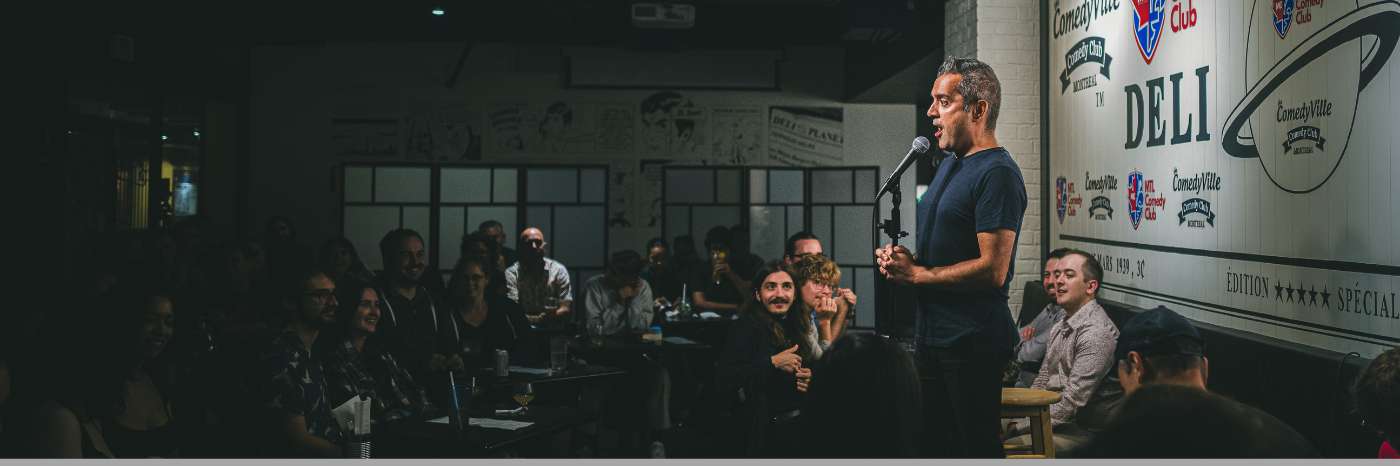
If you’re in Montreal, see what’s happening at Comedyville on our upcoming comedy shows page and experience stand-up where it matters most: in a room full of people.
Post by Eddie Case, exclusively for Comedyville.ca, All rights reserved.
Comedyville is a Comedy Club located in Downtown Montreal.
 Previous Post
 Next Post