
Best Stand-Up Comedy Specials of All Time
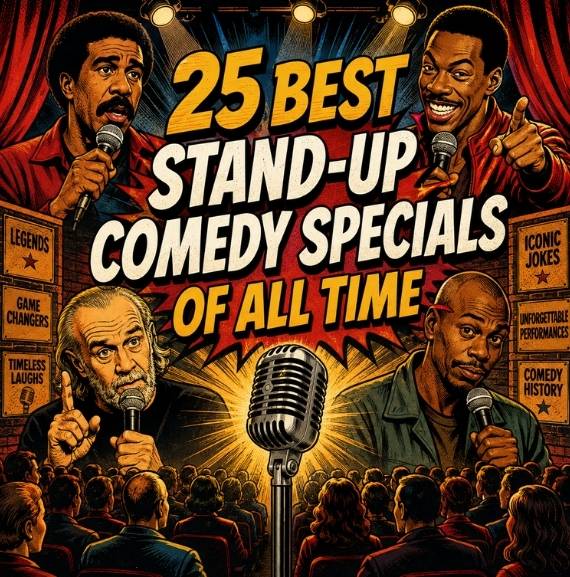
The best stand-up comedy specials of all time do more than capture a comedian telling jokes onstage. The greatest specials can define a comic’s career, influence an entire generation of performers, and change what audiences expect from stand-up comedy.
From Richard Pryor’s groundbreaking performances and George Carlin’s social commentary to Dave Chappelle, Chris Rock, Ali Wong and Bo Burnham, the format has continually evolved.
So which specials truly belong among the greatest ever made?
How We Ranked the Best Stand-Up Comedy Specials
There is no objective formula for deciding which comedy special is the funniest. Comedy is simply too subjective.
Instead of claiming this ranking comes from an unspecified fan poll, we considered four main factors:
- Influence: Did the special change stand-up or inspire other comedians?
- Cultural impact: Did audiences continue discussing it long after its release?
- Performance: How strong are the writing, delivery, storytelling and stage presence?
- Legacy: Has the special remained important years or even decades later?
With those criteria in mind, here are Comedyville’s picks for 25 of the greatest stand-up comedy specials ever made.
1. Richard Pryor: Live in Concert (1979)
Richard Pryor’s Live in Concert remains one of the defining performances in stand-up history.
Pryor combined storytelling, character work, vulnerability and fearless observations about race, relationships and his own life. Instead of simply moving from joke to joke, he made audiences feel as though they were watching someone reveal himself in real time.
Its influence can still be heard in generations of comedians who followed.
Why It Belongs: Few filmed performances had a greater influence on what modern stand-up could become.
Related: Funniest Stand-Up Comedians of All Time
2. Eddie Murphy: Delirious (1983)
At only 22 years old, Eddie Murphy walked onstage in his famous red leather suit and delivered one of comedy’s most recognizable performances.
Delirious showcased extraordinary confidence, physical comedy, impressions and storytelling. Some of its material has aged very differently than its performance style, but its influence on arena-sized stand-up is undeniable.
Why It Belongs: Murphy demonstrated how a comedian could command a stage with the energy of a rock star.
3. George Carlin: Jammin’ in New York (1992)
George Carlin was already a comedy legend when Jammin’ in New York arrived, but this performance captured his social commentary at particularly high intensity.
War, politics, language and environmentalism all became material for Carlin’s tightly constructed observations.
The special illustrates why Carlin remains such an important influence on comedians who use stand-up to challenge how audiences think.
Why It Belongs: It combines precise writing with some of Carlin’s strongest cultural criticism.
4. Chris Rock: Bring the Pain (1996)
Bring the Pain transformed Chris Rock from a respected comedian into one of the biggest stand-up stars of his generation.
His relentless pacing, repetition and ability to build arguments into enormous punchlines gave the performance a rhythm that became unmistakably his own.
Race, relationships, politics and American culture all came under Rock’s microscope.
Why It Belongs: It is one of the clearest examples of a single special changing a comedian’s career.
5. Richard Pryor: Live on the Sunset Strip (1982)
If Live in Concert established the blueprint, Live on the Sunset Strip showed a different Pryor.
After surviving severe personal struggles, he transformed painful experiences into comedy without stripping them of their humanity.
The result is funny, uncomfortable and remarkably personal.
Why It Belongs: Pryor demonstrated that vulnerability and great stand-up could exist in the same performance.
6. Dave Chappelle: Killin’ Them Softly (2000)
Before Chappelle’s Show made him a household name, Killin’ Them Softly demonstrated just how formidable Dave Chappelle already was onstage.
His relaxed delivery contrasts beautifully with the precision of the writing. Stories about race, police encounters, relationships and everyday absurdity unfold conversationally before landing exactly where Chappelle wants them to.
Why It Belongs: It captures Chappelle’s storytelling style before his television fame changed the scale of his career.
7. Robin Williams: Live on Broadway (2002)
Few comedians could generate the sheer velocity Robin Williams brought to a stage.
In Live on Broadway, impressions, physical comedy, improvisation and cultural observations arrive at a staggering pace. Yet beneath the apparent chaos is a performer with remarkable control.
Why It Belongs: It is a showcase of comedic energy and improvisational ability that few performers could match.
8. Chris Rock: Bigger & Blacker (1999)
Three years after Bring the Pain, Chris Rock returned with another landmark HBO performance.
Recorded at the Apollo Theater, Bigger & Blacker tackles politics, relationships, race and American life with Rock’s trademark intensity.
Why It Belongs: Rock proved that Bring the Pain wasn’t a one-time breakthrough.
9. Dave Chappelle: For What It’s Worth (2004)
For What It’s Worth captures Chappelle during the period when his fame was exploding.
The performance combines observational comedy, social commentary and long-form storytelling without losing Chappelle’s deceptively casual stage presence.
Why It Belongs: It captures one of modern comedy’s most influential performers near a pivotal point in his career.
10. Bill Burr: I’m Sorry You Feel That Way (2014)
Bill Burr’s confrontational style works because there is usually more going on underneath the anger.
In I’m Sorry You Feel That Way, Burr takes provocative premises and keeps interrogating them, often turning the joke back on himself.
Why It Belongs: It is an excellent showcase of Burr’s ability to develop an argument until it reaches an unexpected conclusion.
11. Ali Wong: Baby Cobra (2016)
Filmed while Wong was visibly pregnant, Baby Cobra became one of the defining stand-up breakthroughs of the streaming era.
Wong spoke candidly about marriage, ambition, sex, pregnancy and gender expectations with a perspective audiences had rarely seen presented this way in a major comedy special.
Why It Belongs: It launched Wong into international prominence and became an important modern stand-up reference point.
12. Bo Burnham: Inside (2021)
Calling Inside a traditional stand-up special almost undersells what Bo Burnham created.
Produced largely by Burnham during the pandemic, it combines songs, sketches, performance, filmmaking and comedy into a deliberately claustrophobic examination of isolation and internet culture.
Why It Belongs: It expanded the possibilities of what audiences could consider a comedy special.
13. John Mulaney: Kid Gorgeous at Radio City (2018)
John Mulaney’s carefully constructed writing and polished delivery are on full display in Kid Gorgeous at Radio City.
Rather than relying on confrontation or shock, Mulaney turns childhood, adulthood and seemingly mundane experiences into elaborate comic stories.
Why It Belongs: It is one of the strongest examples of precision joke writing in contemporary stand-up.
14. Bill Hicks: Revelations (1993)
Bill Hicks approached stand-up as something closer to a philosophical argument delivered through comedy.
Religion, consumerism, politics and human behaviour become targets in Revelations, while Hicks moves between anger, absurdity and social criticism.
Why It Belongs: His influence remains visible in generations of politically and socially focused comedians.
15. Kevin Hart: Laugh at My Pain (2011)
Kevin Hart turned family stories and personal experiences into a performance that helped propel him toward arena-level fame.
His physical delivery and willingness to make himself the target of the joke made highly personal stories accessible to enormous audiences.
Why It Belongs: It captures the moment Hart’s stand-up career began moving toward another level of commercial success.
Related: How Much Do Stand-Up Comedians Make?
16. Jim Gaffigan: Beyond the Pale (2006)
Food, laziness and family life do not sound like revolutionary comedy subjects, but Jim Gaffigan’s execution made them unmistakably his own.
His famous internal “audience voice” adds another layer to jokes that are already tightly constructed.
Why It Belongs: It helped establish Gaffigan as one of the defining clean observational comedians of his generation.
17. Mitch Hedberg: Comedy Central Presents (1999)
Mitch Hedberg could transform a simple observation into a one-line piece of surreal logic.
His unusual cadence and seemingly effortless delivery made him one of the most distinctive joke writers of his era.
Why It Belongs: Few comedians developed a voice so immediately recognizable.
18. Russell Peters: Outsourced (2006)
Outsourced helped turn Canadian comedian Russell Peters into an international touring phenomenon.
His observations about families, accents and cultural differences connected particularly strongly with multicultural audiences around the world.
Why It Belongs: Peters demonstrated the enormous global audience available to stand-up comedy.
Related: Richest Canadian Comedians
19. Hannah Gadsby: Nanette (2018)
Few comedy specials generated as much debate about the nature of stand-up itself as Nanette.
Gadsby deliberately examines the mechanics and limitations of joke telling while moving between humour, autobiography and painful personal experiences.
Some viewers considered it groundbreaking. Others debated whether it remained stand-up at all. That argument is part of its legacy.
Why It Belongs: It challenged audiences to reconsider what a stand-up special could do.
20. John Mulaney: New in Town (2012)
New in Town helped establish Mulaney’s distinctive combination of storytelling, carefully written language and theatrical delivery.
Stories that initially appear ordinary gradually become increasingly elaborate without sacrificing clarity.
Why It Belongs: It remains one of the performances most closely associated with Mulaney’s rise as a stand-up headliner.
21. Jim Jefferies: Bare (2014)
Jim Jefferies built his reputation on pushing uncomfortable subjects further than many comedians would attempt.
Bare combines confrontational material with extended storytelling, including routines that helped make him widely known to international audiences.
Why It Belongs: It captures Jefferies’ provocative storytelling style at a pivotal point in his career.
22. Eddie Izzard: Dress to Kill (1999)
History, religion, language and surreal imagination collide in Eddie Izzard’s Dress to Kill.
The performance often feels like an elaborate comic journey in which historical figures and absurd scenarios occupy the same universe.
Why It Belongs: Izzard created a style of intellectual absurdism that remains remarkably distinctive.
23. Patrice O’Neal: Elephant in the Room (2011)
Patrice O’Neal’s willingness to follow an uncomfortable idea wherever it led made him deeply respected among fellow comedians.
Elephant in the Room captures his conversational stage presence, crowd interaction and ability to turn provocative observations into extended arguments.
Why It Belongs: O’Neal’s influence among comedians has continued to grow long after his death.
24. Steven Wright: A Steven Wright Special (1985)
Steven Wright proved that enormous laughs did not require enormous movement.
With a nearly expressionless delivery and densely constructed one-liners, Wright created a comic universe built around strange logic and unexpected connections.
Why It Belongs: Wright helped define modern deadpan and one-liner comedy.
25. Ellen DeGeneres: Taste This (1996)
Long before her daytime television career, Ellen DeGeneres was known primarily as a stand-up comedian.
Taste This showcases her observational storytelling and understated approach to everyday situations.
Why It Belongs: It captures an influential observational comedian before television transformed her public career.
Honourable Mentions
Limiting decades of stand-up history to 25 performances inevitably leaves out worthy contenders.
Among the specials that deserve consideration are Dave Chappelle’s Sticks & Stones, George Carlin’s You Are All Diseased, Sebastian Maniscalco’s Stay Hungry, Amy Schumer’s Mostly Sex Stuff, Denis Leary’s No Cure for Cancer, Colin Quinn’s Red State Blue State, Ricky Gervais’ Humanity and several other specials from comedians already represented above.
The list will always be debatable. That’s part of the fun.
Classic vs. Modern Stand-Up Specials
One reason ranking the best stand-up comedy specials is difficult is that the format itself has changed.
Earlier specials were often major television events. HBO and Comedy Central became especially important outlets for stand-up, while DVDs and theatrical releases helped certain performances reach much larger audiences.
Streaming changed that model dramatically. Netflix and other platforms gave comedians access to worldwide audiences and made discovering an older special much easier.
For more decade-specific rankings, see our best stand-up comedy specials of the 2000s.
What Makes a Stand-Up Comedy Special Great?
The funniest special isn’t necessarily the most influential, and the most influential isn’t necessarily the one you’ll personally want to watch again.
The truly enduring performances tend to combine several qualities: an unmistakable comedic voice, strong writing, memorable delivery and the ability to connect with an audience beyond the moment in which they were recorded.
Richard Pryor, George Carlin, Chris Rock and Dave Chappelle sound nothing alike. That difference is precisely the point.
Great stand-up is not about finding one correct way to be funny. It’s about developing a voice audiences couldn’t mistake for anyone else’s.
Frequently Asked Questions About the Best Stand-Up Comedy Specials
What is considered the greatest stand-up comedy special of all time?
There is no universally accepted winner, but Richard Pryor’s Live in Concert is frequently treated as one of stand-up’s landmark filmed performances. Comedyville ranks it first because of its combination of performance, influence and lasting legacy.
What are some of the most influential stand-up comedy specials?
Richard Pryor’s Live in Concert, Eddie Murphy’s Delirious, George Carlin’s Jammin’ in New York, Chris Rock’s Bring the Pain and Dave Chappelle’s Killin’ Them Softly are strong starting points for understanding the evolution of modern stand-up.
What are some of the best modern stand-up comedy specials?
Among the modern entries on this list are Ali Wong’s Baby Cobra, Bo Burnham’s Inside, John Mulaney’s Kid Gorgeous at Radio City, Hannah Gadsby’s Nanette and Bill Burr’s I’m Sorry You Feel That Way.
What are the best stand-up comedy specials on Netflix?
Netflix has released a huge catalogue of stand-up. Comedyville maintains separate guides for Netflix-focused comedy rather than limiting this all-time list to one streaming service.
Are old stand-up comedy specials still worth watching?
Absolutely. Older performances provide both great comedy and a window into the culture in which they were recorded. Some material may have aged differently from modern standards, but historically important performances remain valuable for understanding how stand-up evolved.
Where can I watch classic stand-up comedy specials?
Availability changes frequently by country and streaming service. Search the title on your preferred streaming platform or legitimate rental service rather than assuming an older special remains permanently available on one platform.
What makes a stand-up comedy special one of the best of all time?
Originality, writing, delivery, cultural impact, influence and longevity all matter. A great special should offer more than a collection of good jokes. It should capture a distinctive comedic voice at an exceptional level.
Final Thoughts
The best stand-up comedy specials of all time show just how broad the art form can be.
Richard Pryor turned personal experience into groundbreaking storytelling. George Carlin transformed language and social criticism into comedy. Chris Rock brought extraordinary rhythm and intensity to observational stand-up. Dave Chappelle mastered long-form storytelling, while performers such as Ali Wong, John Mulaney and Bo Burnham pushed the format in new directions.
No Top 25 will settle the debate permanently, and it shouldn’t.
The better question might be: Which special would you put at number one?
If watching these legendary performances makes you want to experience stand-up in person, see what’s happening next at Comedyville in downtown Montreal.
Post by Eddie Case, exclusively for Comedyville.ca, All rights reserved.
Comedyville is a Comedy Club located in Downtown Montreal.
 Previous Post
 Next Post