

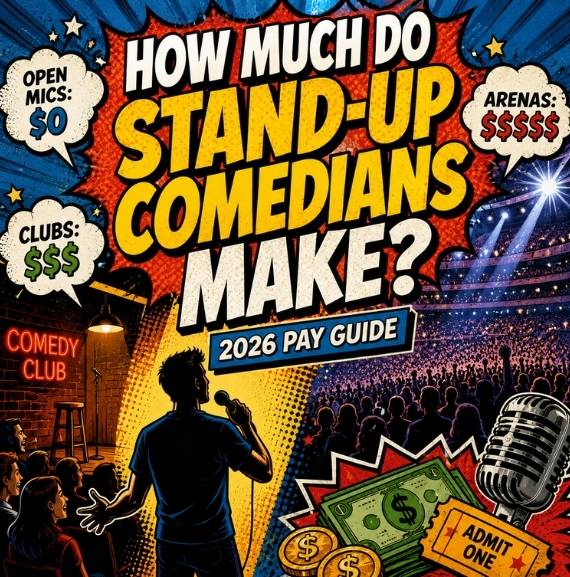
How Much Do Stand-Up Comedians Make?
How much do stand-up comedians make? The answer ranges from nothing at an open mic to millions of dollars in ticket sales for the biggest touring stars.
Most comedians, however, fall somewhere between those extremes. A comic’s income depends on experience, audience size, city, venue, ticket sales, touring schedule and whether they also earn money from private events, podcasts, YouTube, merchandise, television or streaming.
This guide breaks down how stand-up comedians actually get paid, from their first open mic to clubs, theatres and arenas.
Quick Answer: Stand-Up Comedian Pay by Career Level
| Career Level | Typical Pay | How They Usually Earn |
|---|---|---|
| Open mic comedian | Usually unpaid | Open mics and development spots |
| Local booked comic | About $0 to $150 per set | Showcases, bars and local comedy shows |
| Comedy club host | About $25 to $100 per show | Hosting and opening club shows |
| Comedy club feature | About $75 to $300 per show | Longer supporting sets |
| Working headliner | Hundreds to several thousand dollars per show | Club guarantees, ticket splits and touring |
| Established touring comedian | Thousands to tens of thousands per show | Theatres, tours, private events and media |
| Major comedy star | Potentially millions in annual touring revenue | Arenas, streaming, production, sponsorships and other businesses |
These are broad industry ranges, not guaranteed rates. Comedy pay varies significantly by market, venue, ticket sales, experience and the comedian’s ability to draw an audience.
🎤 Do Open Mic Comedians Get Paid?
Usually, no.
Open mics are primarily places for comedians to develop material and gain stage experience. New comedians often perform short sets without receiving any payment.
In some cases, performers may even need to purchase a drink, pay a small signup fee or bring audience members to participate.
At this stage, the objective generally isn’t income. It’s becoming comfortable on stage, developing material and eventually getting booked for paid shows.
💵 How Much Do Local Stand-Up Comedians Make?
Once comedians begin getting booked outside open mics, they may start receiving small performance fees.
A local comic performing a short set might receive anywhere from nothing to around $50, while a longer paid local set can sometimes bring approximately $25 to $150.
Not every independent show pays the same way. Some producers offer a flat fee, others split ticket revenue, and some shows simply provide stage time and exposure.
This is one reason comedians can perform regularly without necessarily earning enough from stand-up alone to make it their full-time occupation.
🎭 How Much Do Comedy Club Comedians Make?
Traditional comedy clubs generally divide performers into several roles.
Comedy Club Host or MC
The host opens the show, interacts with the audience and introduces the other comedians.
Industry estimates commonly place club host pay around $25 to $100 per show, although rates vary considerably by club and market.
Feature Comedian
The feature usually performs a longer set before the headliner and is often an experienced working comedian.
Feature comedians may earn approximately $75 to $300 per show, with higher rates possible depending on the venue, market and performer.
Comedy Club Headliner
Headliner compensation varies much more widely.
A working headliner might receive a flat guarantee, a percentage of ticket sales or a combination of both. Travel, accommodation and merchandise arrangements can also affect the value of the booking.
A comedian who can consistently sell tickets is in a much stronger negotiating position than someone who simply has strong material but little audience recognition.
🎟️ Ticket Sales Change Everything
The economics of stand-up change dramatically when comedians begin selling their own tickets.
A comedian performing to 100 people in a club operates in a completely different financial world from a comedian selling thousands of seats in an arena.
This is why reported tour grosses can become enormous.
Pollstar’s 2025 comedy touring data, published in 2026, reported that the 100 highest-grossing comedy acts generated approximately $696 million and sold more than 9.3 million tickets.
Nate Bargatze led the ranking with approximately $77.5 million in reported ticket gross from 93 shows and 962,955 tickets sold. Sebastian Maniscalco followed with approximately $43.5 million, while Matt Rife generated approximately $33.5 million.
But there is an important distinction:
Tour gross is not the comedian’s salary.
Gross ticket revenue may need to cover promoters, venues, production, advertising, transportation, crew, management, agents, taxes and other touring expenses before determining what the performer actually earns.
For a deeper look at those numbers, see our highest-paid stand-up comedians guide.
🏟️ How Much Can Arena Comedians Generate?
At the highest level, stand-up has become a major live entertainment business.
Pollstar reported approximately $837 million in worldwide comedy-event grosses during its 2025 chart year, with 12.3 million fans attending comedy performances.
The biggest comedians can generate hundreds of thousands or even more than $1 million in gross ticket revenue around a performance, depending on venue capacity, ticket prices and the number of shows included in the reported engagement.
Again, those figures describe box-office revenue rather than personal take-home income.
📺 How Much Does Netflix Pay Stand-Up Comedians?
There is no standard public Netflix rate for a stand-up comedy special.
Deals can vary dramatically depending on the comedian’s audience, negotiating power, production arrangement, exclusivity and rights involved.
Major stars have historically signed very large streaming agreements, but those headline-making deals should not be treated as normal compensation for working comedians.
For many performers, the value of a streaming special isn’t limited to the payment for the special itself. Global exposure can increase ticket demand, social-media audiences and future booking opportunities.
That’s why a successful special can change a comedian’s career even when the financial terms remain private.
🏢 How Much Do Comedians Make at Corporate and Private Events?
Corporate comedy can pay significantly more than a regular club spot because the client is hiring a performer specifically for a private audience.
A working comedian might earn hundreds or several thousand dollars for a private event, while experienced touring performers and nationally recognized comedians can command considerably more.
The fee depends on factors including:
- Length of performance
- Travel requirements
- Size of the audience
- Whether customized material is requested
- Corporate or private-event experience
- Television or streaming credits
- The comedian’s public profile
Corporate work can therefore become an important source of income for comedians who are not yet selling thousands of tickets under their own name.
🎙️ Podcasts, YouTube and Social Media
Modern comedians don’t necessarily rely on stage fees alone.
Podcasts, YouTube and social media can help comedians earn money while also building an audience for their live shows.
Possible revenue sources include:
- Podcast advertising and sponsorships
- YouTube advertising revenue
- Paid memberships and subscriptions
- Patreon or other fan-supported platforms
- Brand partnerships
- Live podcast events
For many comedians, the biggest benefit of online content may actually be ticket sales. A viral clip can introduce a performer to thousands or millions of people who may later buy tickets when that comedian tours their city.
👕 How Much Can Comedians Make From Merchandise?
Merchandise can provide another revenue stream, particularly for touring comedians with recognizable brands or loyal audiences.
Common merchandise includes shirts, hats, posters and other branded products.
The economics can be attractive because the comedian already has a concentrated group of fans leaving a live performance. However, manufacturing costs, payment processing, staffing and venue merchandise commissions can reduce the profit.
💼 Do Stand-Up Comedians Have Salaries?
Usually not.
Most stand-up comedians operate more like independent contractors or self-employed entertainers than salaried employees.
Income can therefore fluctuate significantly from month to month.
A comedian might have a profitable touring month followed by several weeks spent writing, developing material or performing lower-paying club dates.
This irregularity is one of the biggest differences between a comedy career and a conventional salaried job.
💸 Gross Revenue vs. What a Comedian Actually Keeps
This is one of the most misunderstood parts of comedian earnings.
If a show generates $100,000 at the box office, that does not mean the comedian takes home $100,000.
Depending on the arrangement, expenses can include:
- Venue costs
- Promoter fees
- Agent and management commissions
- Production staff
- Opening performers
- Travel and accommodation
- Advertising
- Insurance
- Equipment and production
- Taxes
The larger the tour becomes, the more substantial these expenses can become as well.
That’s why we distinguish between tour gross, performance fee and personal income when discussing comedian earnings.
📈 How Do Comedians Increase Their Income?
The traditional path was simple: perform frequently, become a headliner and eventually move into theatres.
That path still exists, but comedians now have more ways to build an audience independently.
A modern comedian might develop through:
- Open mics and local shows
- Paid club spots
- Hosting and feature work
- Headlining comedy clubs
- Posting stand-up clips online
- Building a podcast or YouTube audience
- Corporate and private performances
- Touring theatres
- Streaming or television specials
- Arena touring
The key financial transition usually occurs when audiences begin buying tickets specifically to see that comedian.
Can You Make a Living as a Stand-Up Comedian?
Yes, but making a living from stand-up is very different from becoming famous.
Working comedians can build careers through a combination of club performances, touring, hosting, private events, writing, content creation and other entertainment work.
The challenge is consistency. Because most comedians aren’t salaried, earning a sustainable income often requires several revenue sources rather than relying exclusively on individual stand-up sets.
Frequently Asked Questions About Stand-Up Comedian Pay
How much does a beginner stand-up comedian make?
Beginners frequently make nothing. Open mics are usually unpaid, and early booked spots may pay little or nothing while a comedian develops material, experience and industry relationships.
How much do comedy clubs pay comedians?
Pay varies by role and market. Hosts may earn roughly $25 to $100 per show, while feature comedians can earn approximately $75 to $300 per show. Headliner compensation varies much more widely and may involve guarantees or ticket-revenue splits.
How much does a professional comedian make per show?
There is no standard rate. A local performer might earn a small fee, an established club headliner can earn hundreds or thousands of dollars, and major touring comedians can generate very large box-office grosses from theatre and arena performances.
Do comedians get paid for open mics?
Usually not. Open mics are primarily used to develop material and gain stage experience rather than earn income.
How much does Netflix pay comedians?
Netflix does not have one publicly disclosed standard rate for stand-up specials. Individual deals depend on the comedian, rights, production arrangement and negotiating leverage.
Who generates the most money from comedy tours?
Recent Pollstar data placed Nate Bargatze at the top of its 2025 comedy touring chart with approximately $77.5 million in reported gross ticket sales. Tour gross should not be confused with the comedian’s personal income.
🎤 The Bottom Line
Stand-up comedy has one of the widest income ranges in entertainment. A new comedian may perform for free while learning the craft, a working professional may piece together income from clubs and private events, and the biggest stars can generate tens of millions of dollars in annual ticket sales.
The biggest financial difference isn’t simply how funny someone is. It’s whether enough people know that comedian and are willing to pay to see them.
And nearly every comedian starts in the same place: a microphone, a few minutes of material and a live audience.
Thinking about trying stand-up yourself? Read our guide to performing at a comedy show for the first time.
Want to see working comedians live? Check out upcoming comedy shows at Comedyville in Montreal.
Post by Eddie Case, exclusively for Comedyville.ca, All rights reserved.
Comedyville is a Comedy Club located in Downtown Montreal.
 Previous Post
 Next Post