
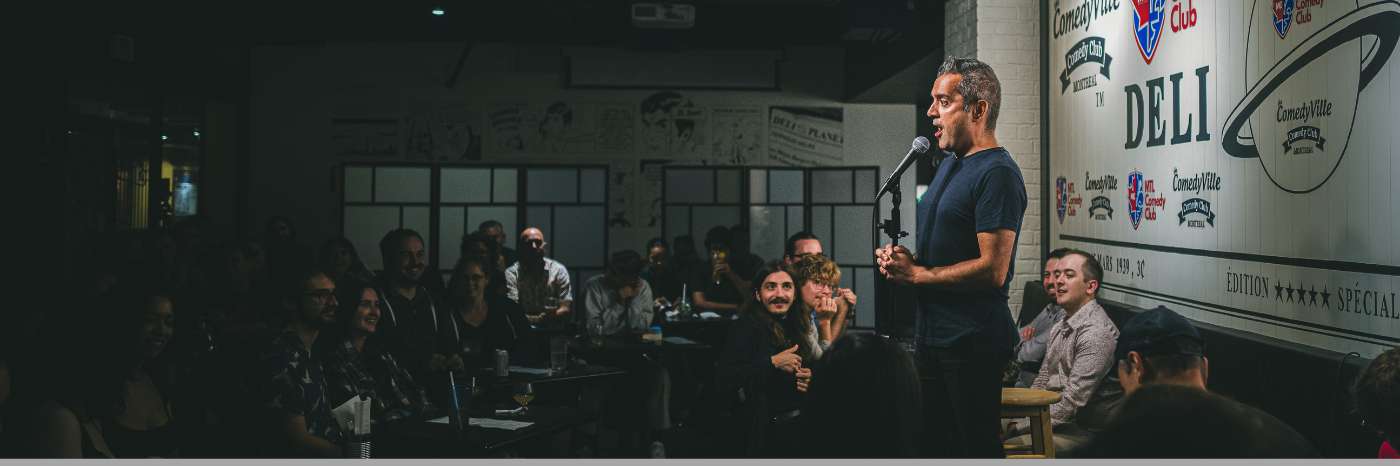
Stand-up comedy comes in many different styles. Some comedians build their acts around everyday observations, while others rely on storytelling, one-liners, satire, characters, dark humour or interactions with the audience.
Most professional comedians don’t fit perfectly into just one category. They often combine several styles of stand-up comedy to create their own voice. Dave Chappelle, for example, combines storytelling and social commentary, while Jerry Seinfeld is closely associated with observational comedy.
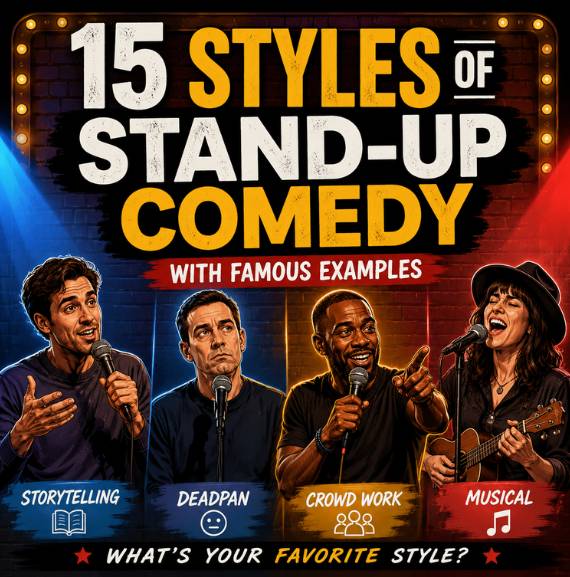
Whether you’re discovering stand-up for the first time or trying to understand how different comedians approach the craft, here are 15 of the most recognizable styles of stand-up comedy, along with famous examples.
15 Different Styles of Stand-Up Comedy
| # | Comedy Style | Famous Examples |
|---|---|---|
| 1 | Observational Comedy | Jerry Seinfeld, George Carlin |
| 2 | Storytelling / Anecdotal Comedy | Richard Pryor, Dave Chappelle |
| 3 | One-Liner Comedy | Mitch Hedberg, Rodney Dangerfield |
| 4 | Deadpan Comedy | Steven Wright, Norm Macdonald |
| 5 | Satirical Comedy | George Carlin, Chris Rock |
| 6 | Topical Comedy | Dave Chappelle, Bill Maher |
| 7 | Insult / Roast Comedy | Don Rickles, Jeff Ross |
| 8 | Self-Deprecating Comedy | Rodney Dangerfield, Joan Rivers |
| 9 | Dark Comedy | Anthony Jeselnik, Ricky Gervais |
| 10 | Alternative Comedy | Maria Bamford, Patton Oswalt |
| 11 | Absurdist / Surreal Comedy | Emo Philips, Eddie Izzard |
| 12 | Character Comedy | Robin Williams, Sarah Silverman |
| 13 | Musical Comedy | Bo Burnham, Tim Minchin |
| 14 | Prop Comedy | Carrot Top, Gallagher |
| 15 | Crowd Work / Improvisational Stand-Up | Don Rickles, Dave Attell |
1. Observational Comedy
Observational comedy finds humour in ordinary experiences and behaviours that audiences immediately recognize.
Dating, relationships, travel, technology, food, work and everyday social habits can all become material. The comedian’s job is to notice something familiar and present it from an angle the audience may never have considered.
Famous examples: Jerry Seinfeld and George Carlin.
Seinfeld became particularly associated with turning tiny details of everyday life into carefully constructed jokes. Carlin often began with observations about ordinary behaviour before expanding them into larger ideas about language and society.
2. Storytelling / Anecdotal Comedy
Storytelling comedy uses longer narratives rather than relying entirely on short setups and punchlines.
The comedian may tell a story about childhood, relationships, family, travel or an embarrassing personal experience. Characters, dialogue and callbacks can be used to build laughs throughout the story before reaching a larger payoff.
Famous examples: Richard Pryor and Dave Chappelle.
Pryor helped transform personal storytelling in modern stand-up, while Chappelle frequently uses extended stories to explore larger cultural and social ideas.
3. One-Liner Comedy
One-liner comedians specialize in short, tightly constructed jokes that can deliver a punchline within seconds.
Instead of developing a long story, the comedian quickly establishes an idea and then surprises the audience with a punchline, reversal or unexpected interpretation.
Famous examples: Mitch Hedberg and Rodney Dangerfield.
4. Deadpan Comedy
Deadpan comedy depends heavily on delivery. The comedian says something absurd, surprising or ridiculous while maintaining a serious expression and controlled tone.
The contrast between the material and the performer’s apparent lack of emotion creates much of the humour.
Famous examples: Steven Wright and Norm Macdonald.
5. Satirical Comedy
Satirical comedy uses humour to criticize or expose problems in society, politics, institutions and human behaviour.
Rather than simply commenting on an issue, satire often exaggerates ideas or exposes contradictions to make a larger point.
Famous examples: George Carlin and Chris Rock.
6. Topical Comedy
Topical comedy focuses on current events, politics, celebrities, cultural controversies and stories dominating public conversation.
Because the material is tied to events happening at a particular moment, topical comedians often need to write and update material quickly.
Famous examples: Dave Chappelle and Bill Maher.
7. Insult and Roast Comedy
Insult comedy deliberately makes another person the target of the joke.
The performer might tease another comedian, celebrity or audience member. In roast comedy, everyone generally understands that exaggerated insults are part of the format.
Famous examples: Don Rickles and Jeff Ross.
8. Self-Deprecating Comedy
In self-deprecating comedy, the comedian makes themselves the target.
Performers might joke about their appearance, relationships, personality, career, failures or insecurities.
Famous examples: Rodney Dangerfield and Joan Rivers.
9. Dark Comedy
Dark comedy finds humour in subjects that are normally considered uncomfortable, serious or taboo.
Death, illness, tragedy, morality and controversial social issues can become material, but successful dark comedy depends heavily on joke construction, perspective and audience expectations.
Famous examples: Anthony Jeselnik and Ricky Gervais.
10. Alternative Comedy
Alternative comedy deliberately moves away from conventional stand-up structures.
Instead of relying entirely on traditional setups and punchlines, alternative comedians may experiment with storytelling, characters, theatrical elements, unusual structures or deliberately unconventional ideas.
Famous examples: Maria Bamford and Patton Oswalt.
11. Absurdist and Surreal Comedy
Absurdist comedy creates humour through strange logic, impossible situations and unexpected connections between ideas.
The comedian may deliberately abandon realistic assumptions and invite the audience into a bizarre version of reality.
Famous examples: Emo Philips and Eddie Izzard.
12. Character Comedy
Character comedy involves performing through exaggerated personalities, voices, impressions or fictional characters.
Some stand-up comedians briefly shift into characters during stories, while others build substantial portions of their performance around them.
Famous examples: Robin Williams and Sarah Silverman.
13. Musical Comedy
Musical comedians use songs, instruments and musical performance as part of their stand-up.
The humour may come from parody, unexpected lyrics, musical storytelling or the contrast between impressive musicianship and ridiculous subject matter.
Famous examples: Bo Burnham and Tim Minchin.
14. Prop Comedy
Prop comedy uses physical objects as an important part of the joke.
Instead of relying only on spoken material, performers use costumes, visual gags, objects or specially created props to generate laughs.
Famous examples: Carrot Top and Gallagher.
15. Crowd Work and Improvisational Stand-Up
Crowd work happens when a comedian interacts directly with audience members and creates comedy from their answers or reactions.
Unlike prepared stand-up material, these exchanges can be unpredictable. The comedian needs strong listening skills, timing and the ability to quickly find a funny angle in whatever information the audience provides.
Famous examples: Don Rickles and Dave Attell.
Traditional improvisational theatre and stand-up comedy are separate art forms, but improvisation is an important skill in crowd work. Many modern stand-up comedians also post crowd-work clips online because every audience interaction produces something different.
Can a Comedian Use More Than One Style?
Absolutely. In fact, most successful stand-up comedians combine several styles.
Dave Chappelle combines storytelling, topical comedy and social commentary. George Carlin mixed observational comedy with satire. Robin Williams combined characters, improvisation and physical performance. Joan Rivers mixed one-liners, insults and self-deprecating humour.
A comedian’s individual voice often develops from the particular combination of styles they use rather than from fitting perfectly into one category.
What Is the Most Popular Style of Stand-Up Comedy?
Observational comedy remains one of the most recognizable forms because almost anyone can relate to jokes about everyday life.
Storytelling and crowd work have also become increasingly visible, particularly as streaming specials, podcasts and short comedy clips have changed how audiences discover comedians.
There isn’t one style that is inherently funnier than another. A comedian’s writing, perspective, delivery and connection with the audience ultimately matter more than the category.
How Do Comedians Develop Their Own Style?
Most comedians don’t decide on a permanent style before they begin performing. Their voice develops through writing, performing and discovering which ideas feel natural onstage.
A new comedian might begin with observational jokes, experiment with storytelling, try crowd work and eventually discover that their strongest material combines several approaches.
Watching different comedians can help you recognize those differences. Our ranking of the funniest stand-up comedians of all time shows how dramatically style can vary between legendary performers.
Frequently Asked Questions About Stand-Up Comedy Styles
What are the main styles of stand-up comedy?
Common styles include observational comedy, storytelling, one-liners, deadpan, satire, topical comedy, insult comedy, self-deprecating comedy, dark comedy, alternative comedy, absurdist comedy, character comedy, musical comedy, prop comedy and crowd work.
What is observational stand-up comedy?
Observational comedy finds humour in familiar experiences and everyday behaviour. Jerry Seinfeld is one of the best-known examples of an observational stand-up comedian.
What is storytelling comedy?
Storytelling comedy uses longer narratives, characters and personal experiences to generate laughs. Richard Pryor and Dave Chappelle are famous examples of comedians who use storytelling extensively.
What is the difference between satire and topical comedy?
Topical comedy focuses on current events and subjects receiving attention right now. Satire uses humour to criticize or expose ideas, institutions and behaviour. A comedian can use both styles in the same routine.
Is crowd work a style of stand-up comedy?
Yes. Crowd work is a form of stand-up in which comedians interact directly with audience members and create humour from those conversations. It relies heavily on improvisational ability.
Is improv the same as stand-up comedy?
No. Traditional improv usually involves performers creating scenes without a prepared script, often with multiple performers onstage. Stand-up generally features one comedian addressing an audience. However, stand-up comedians frequently use improvisation during crowd work and unexpected moments.
Experience Different Styles of Stand-Up Comedy Live
The easiest way to understand different comedy styles is to see them performed live. On the same night, one comedian might tell personal stories, another might deliver rapid-fire one-liners and another might spend part of the set talking directly to the audience.
Comedyville presents professional and emerging stand-up comedians in downtown Montreal. See our upcoming comedy shows in Montreal and discover which style makes you laugh the most.
Post by Eddie Case, exclusively for Comedyville.ca, All rights reserved.
Comedyville is a Comedy Club located in Downtown Montreal.
 Previous Post
 Next Post